Table of Contents
You know that feeling when you wake up on a Saturday morning and actually have time to make a real breakfast? Not the grab-a-granola-bar-and-run kind, but the kind where you can shuffle around your kitchen in your slippers and make something that smells amazing?
That’s what this French toast is all about.
I’m going to be straight with you—I’ve made terrible French toast. The kind that’s basically scrambled eggs masquerading as bread. The kind that’s burnt on the outside and somehow still raw in the middle. The kind my kids took one bite of and asked if we could have cereal instead (ouch).
But here’s the thing: once I figured out the actual technique, everything changed. Now I can make French toast that’s genuinely fluffy, perfectly golden, and ready in the time it takes my coffee to brew—no fancy equipment, no culinary degree, just a few simple tricks that make all the difference.
Let me show you how.
Why Most French Toast Sucks (And How to Fix It)
Look, French toast shouldn’t be complicated. It’s literally just bread and eggs. But somehow, most of us learned to make it wrong.
The biggest problem? Drowning your bread in the egg mixture like you’re trying to bathe it. When you do that, you end up with soggy, eggy bread that falls apart when you try to flip it. Not exactly appetizing.
Here’s what actually works: your bread needs just enough egg mixture to coat it—think of it like you’re giving it a nice, even covering, not soaking it until it can’t hold its shape anymore.
The other issue is bread thickness. Those regular sandwich slices? Too thin. They can’t handle the egg mixture and still maintain any structure. You need something substantial—the thick stuff that’s almost an inch tall. That’s what gives you room for a fluffy inside and a crispy outside.
And one more thing that nobody talks about: slightly stale bread is actually better. Fresh bread has too much moisture already, so adding the egg mixture on top just makes it mushy. Day-old bread has dried out a bit, which means it can actually absorb the good stuff without turning into a wet mess.
What You Actually Need
Let’s keep this simple. Here’s your shopping list:
The Basics:
- 4 eggs – Just regular large eggs from the grocery store
- ½ cup milk – Whole milk works best, but use whatever you’ve got
- 2 tablespoons sugar – For a hint of sweetness
- 1 teaspoon vanilla – Please use the real stuff, not imitation
- 1 teaspoon cinnamon – The good kind that actually smells like something
- ¼ teaspoon salt – Don’t skip this
- 8 thick slices of bread – We’ll talk about bread in a second
- Butter for cooking – A couple of tablespoons, plus more for serving
That’s it. Eight ingredients, most of which you probably already have.
If You Want to Get Fancy:
Sometimes I’ll add a tiny pinch of nutmeg, or a splash of heavy cream to make it extra rich. But honestly? The basic version is so good that you don’t really need anything else.
Let’s Talk About Bread
This is important, so pay attention.
The best French toast I’ve ever made used brioche. It’s that soft, slightly sweet bread that costs way too much but tastes incredible. The eggs and butter in brioche make it perfect for French toast—it soaks up the mixture beautifully and gets this amazing custardy texture.
Second best? Challah. It’s similar to brioche but usually cheaper and easier to find. Plus, it comes in those beautiful braided loaves that make you feel fancy.
But here’s the real talk: Texas Toast (that super-thick white bread in the freezer section) works great. I’ve made French toast with it dozens of times, and my family has never complained. Sometimes simple is perfectly fine.
Whatever bread you pick, it needs to be thick. I’m talking at least ¾ of an inch. Those wimpy sandwich slices just don’t cut it.
And here’s a trick I learned by accident: if your bread is fresh out of the bag, lay the slices on a baking sheet and stick them in a 300°F oven for about five minutes. This dries them out just enough to make perfect French toast. I discovered this when I forgot I’d left bread in the oven, and it turned out amazing.
Okay, Let’s Actually Make This Thing
Step 1 – Mix Your Egg Stuff (3 minutes)
Grab a wide, shallow bowl. A pie dish works perfectly.
Crack your eggs in there, then add the milk, sugar, vanilla, cinnamon, and salt. Now here’s where most people mess up—they give it a couple of lazy stirs with a fork and call it good.
Don’t do that.
You need to whisk this thing like you mean it. I’m talking 30-45 seconds of actual effort. Your arm should get a little tired. Why? Because you’re beating air into the mixture, and those air bubbles are what make your French toast fluffy instead of flat and dense.
You’ll know you’re done when everything’s completely mixed together with no white streaks, and the surface looks a little frothy. That frothy part isn’t just for show—it actually matters.
Step 2 – The Soaking Part (2 minutes)
Put your pan on the stove over medium heat. Not medium-high, not high—medium. Let it warm up while you’re doing the next part.
Now, take one slice of bread and put it in your egg mixture. Let it sit there for 15-20 seconds. Count it out if you need to. Flip it over and give the other side the same amount of time.
That’s it. Seriously.
I used to let my bread soak for like a minute because I thought more soaking = more flavor. Nope. More soaking = a soggy disaster that falls apart in the pan. All you’re doing is coating the bread thoroughly, not turning it into a sponge.
When you pick up the bread, it should feel heavier and look saturated, but it shouldn’t be dripping all over the place. Give it a little shake over the bowl to let the excess drip off.
Step 3 – Cook It (8-10 minutes)
By now, your pan should be hot. Drop in about half a tablespoon of butter and let it melt, swirling it around to coat the pan. The butter should sizzle when it hits the pan, but not smoke or turn brown right away.
Put your bread in the pan and then—this is crucial—leave it alone. Don’t poke it, don’t press on it with the spatula, don’t check it every 30 seconds. Just let it cook for 3-4 minutes.
I know it’s tempting to peek, but resist. Your French toast needs that uninterrupted time to develop a proper crust and cook through.
After 3-4 minutes, slide your spatula underneath and flip it. You’re looking for a deep golden brown color, almost caramel-colored. If it’s pale, give it another minute before flipping.
The second side cooks faster—usually about 3 minutes. You’ll know it’s done when both sides are that gorgeous golden brown and when you press gently with your spatula, the bread springs back instead of feeling mushy.
If you want to be really sure it’s cooked through (especially if you’re making this for kids), the inside should hit 160°F. But honestly, if both sides are properly browned and it feels firm when you press it, you’re good.
Step 4 – Eat It Immediately (2 minutes)
French toast doesn’t like to wait around. It’s best within about five minutes of coming off the stove. After that, it starts to deflate and lose that perfect texture.
If you’re cooking for a crowd and need to make multiple batches, turn your oven to 200°F and put finished pieces on a wire rack set over a baking sheet. The low heat keeps them warm without overcooking, and the wire rack prevents the bottoms from getting soggy.
Just don’t stack them or cover them with foil—that traps steam and makes everything soft and sad.
What to Put on Top
I’m going to be honest—sometimes I just do butter and maple syrup. Real maple syrup, the expensive stuff from Vermont or Canada, not that corn syrup nonsense. There’s something about the combination of melted butter and real maple syrup that just works.
But if you want to mix it up:
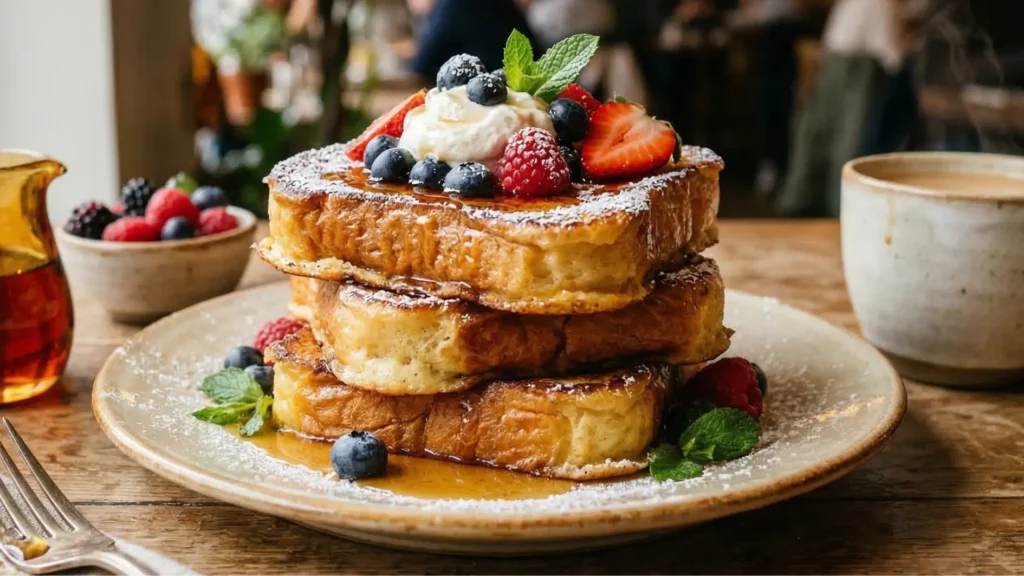
Fresh berries and powdered sugar are stupidly simple but look impressive. Just pile on some strawberries, blueberries, and raspberries, dust the whole thing with powdered sugar, and boom—you look like you know what you’re doing.
Whipped cream and strawberries turn breakfast into dessert, which is perfectly acceptable on weekends.
Caramelized bananas are worth the extra two minutes. Slice up a banana, throw it in a pan with butter and brown sugar, cook until it’s all golden and sticky, then dump it on top of your French toast. Add some chopped pecans if you’re feeling fancy.
Here’s a quick trick I use all the time: berry compote. Throw a cup of frozen berries in a small pot with two tablespoons of sugar and a squeeze of lemon juice. Simmer it for five minutes while your French toast cooks. The berries break down into this jammy sauce that’s so much better than syrup.
The Mistakes I Made So You Don’t Have To
Mistake 1: Soggy, Gross Centers
This happened because I soaked my bread for way too long. Twenty seconds per side, people. Set a timer if you have to. Also, if your heat is too high, you’ll burn the outside before the inside cooks. Medium heat only.
Mistake 2: Burnt Outside, Raw Inside
My pan was too hot. I thought high heat would cook it faster, but all it did was burn the sugars on the outside while leaving the middle undercooked. Again: medium heat is your friend.
Mistake 3: Flat, Dense French Toast
I didn’t whisk the eggs enough, so there was no air in the mixture. Also, I kept pressing down on the bread with my spatula while it cooked, which squeezed out all the air. Whisk thoroughly, then leave it alone while it cooks.
Mistake 4: Everything Falling Apart
I used regular sandwich bread that was too thin and fresh. Thick bread that’s a day old (or dried in the oven) holds up way better.
Some Fun Variations
Once you nail the basic recipe, you can mess around with it.
For pumpkin spice French toast, add two tablespoons of canned pumpkin to your egg mixture along with some pumpkin pie spice instead of regular cinnamon. It tastes like fall in breakfast form.
For chocolate French toast, whisk in two tablespoons of cocoa powder and throw in some chocolate chips. Top with more chocolate chips and whipped cream. This is basically dessert pretending to be breakfast, and I’m here for it.
For lemon blueberry, add the zest of a lemon to your egg mixture and toss in some fresh blueberries. It’s refreshing and feels a little lighter than the regular version.
If you need to make it dairy-free, use almond milk or oat milk instead of regular milk, and cook with coconut oil instead of butter. Still tastes great.
For gluten-free, just use thick gluten-free bread. Canyon Bakehouse makes good stuff.
Can You Make This Ahead?
Sort of.
You can mix up the egg mixture the night before, cover it, and stick it in the fridge. In the morning, give it a quick whisk, and you’re ready to go. That saves you a few minutes when you’re half-asleep.
But here’s what you absolutely cannot do: soak the bread ahead of time. I tried this once, thinking I’d be smart and prep everything the night before. The bread turned into complete mush overnight and was completely unsalvageable. Don’t be like me.
If you want true make-ahead French toast, cook it completely, let it cool, then freeze it. You can freeze it for up to two months. To reheat, either pop it in the toaster (seriously, it works) or put it in a 375°F oven for about 8-10 minutes. It won’t be quite as perfect as fresh, but it’s pretty damn close and way better than anything from the freezer section at the store.
The Bottom Line
Making really good French toast isn’t hard once you know the tricks. Thick bread, quick soak, medium heat. That’s basically it.
I make this probably twice a month now, usually on Saturday mornings when we’re not rushing anywhere. It’s become one of those things my kids actually request, which, as a parent, feels like a small victory.
The first time you make this, follow the recipe exactly. Don’t try to get creative or skip steps. Once you nail it once, you’ll understand how it’s supposed to look and feel, and then you can start experimenting.
And look, even if you mess it up the first time, it’s still eggs and bread and cinnamon. It’ll still taste pretty good. But get it right, and you’ll have people asking for your recipe.
Now go make some French toast. Your Saturday morning is calling.
Drop a comment below and tell me how it turned out—especially if you tried one of the variations. And if you’ve got your own French toast tricks, I want to hear them. We’re all just trying to make a decent breakfast here.