Table of Contents
There’s a specific kind of hunger that hits around midday — not the ravenous, stomach-growling kind, but the quieter one. The kind where nothing in your fridge looks interesting, takeout feels like a defeat, and you just want something that tastes good without making you feel heavy afterward.
If you’ve ever had a really great Chinese chicken salad, you already know it’s one of the few dishes that solves all of that at once. It’s the salad that doesn’t feel like a salad. The one that leaves you genuinely full, genuinely satisfied, and somehow already thinking about making it again tomorrow.
This recipe is my attempt to capture exactly that feeling — and then make it something you can pull off on a weeknight in about 25 minutes, with ingredients you can find at any grocery store. No fancy equipment, no obscure pantry items, no culinary degree required.
What you do need is a good shredding technique, a decent knife, and about 10 minutes of patience while the dressing sits in the fridge and does its thing. That’s genuinely it.
Let’s get started.
What Actually Is Chinese Chicken Salad — And Why Has It Never Gone Out of Style?
The Backstory (It’s More Interesting Than You’d Think)
Here’s something that surprises most people: Chinese chicken salad has almost nothing to do with Chinese cuisine. It’s a California invention — a Chinese-American creation that became wildly popular in the 1960s and 70s, largely credited to chef Wolfgang Puck and a Santa Monica restaurant called Madame Wu’s Garden.
It borrowed the flavor language of Asian cooking — sesame, soy, ginger, rice vinegar — and applied it to a format that American diners were already comfortable with. The result was something that felt familiar and exciting at the same time, and it never really stopped being popular.
Decades later, it’s still on menus everywhere. That kind of staying power doesn’t happen by accident.
Why This Particular Salad Hits Different
Most salads are fine. They fill a role. You eat them because you feel like you should, not because you genuinely want to.
This one’s different, and it comes down to a few things working together at the right time:
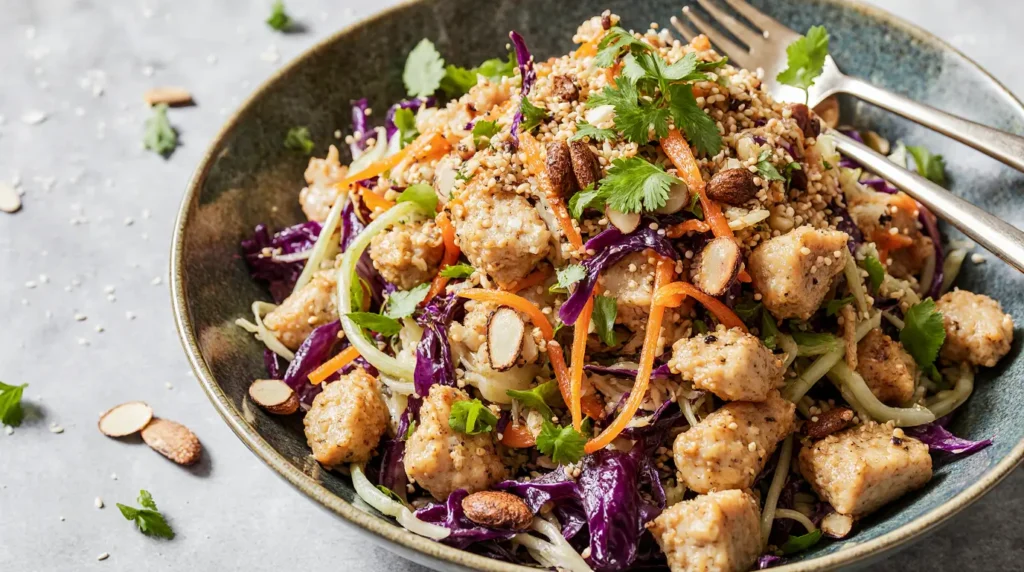
The cabbage base stays crunchy where lettuce would wilt. The sesame-soy dressing has enough depth to stand on its own. The mandarin oranges add a sweetness that cuts through the savory without feeling out of place. And the toasted almonds — this is the part people underestimate — add a warmth and nuttiness that ties the whole thing together.
It’s also filling in a way that most salads aren’t. Between the lean chicken, the fiber from the cabbage, and the healthy fats from the almonds and sesame oil, you’re not hungry again an hour later. That alone makes it worth coming back to.
What You’ll Need
For the Salad
Here’s the full shopping list laid out cleanly. The good news: once you’ve made this a couple of times, you’ll start eyeballing most of it.
| Category | Ingredient | Quantity | Notes |
|---|---|---|---|
| Protein | Boneless skinless chicken breast | 2 large | Grilled, poached, or rotisserie |
| Greens | Napa cabbage | 3 cups, shredded | Green cabbage works in a pinch |
| Greens | Red cabbage | 1 cup, shredded | Adds color and a mild pepperiness |
| Greens | Romaine lettuce | 1 cup, chopped | Gives a bit of extra crunch |
| Vegetables | Carrots | 1 cup, shredded | Pre-shredded bags are fine |
| Vegetables | Cucumber | 1 medium, thinly sliced | English cucumber preferred |
| Vegetables | Edamame | ½ cup, shelled | Frozen and thawed work perfectly |
| Toppings | Sliced almonds | ¼ cup | Toast them — it matters |
| Toppings | Mandarin oranges | ½ cup | Canned in juice, not syrup |
| Toppings | Wonton strips | ¼ cup | Optional, but worth it occasionally |
| Toppings | Sesame seeds | 1 tbsp | White, black, or both |
| Herbs | Fresh cilantro | ¼ cup | Leave it out if you’re anti-cilantro |
| Herbs | Green onions | 3 stalks, sliced |
For the Sesame Ginger Dressing
This dressing is genuinely the heart of the recipe. Make extra — you’ll want it on other things.
| Ingredient | Quantity | Notes |
|---|---|---|
| Low-sodium soy sauce or tamari | 3 tbsp | Tamari for gluten-free |
| Rice vinegar | 2 tbsp | Don’t swap for white vinegar — too sharp |
| Toasted sesame oil | 1 tbsp | This is non-negotiable |
| Fresh ginger, grated | 1 tsp | Ground ginger works, but fresh is noticeably better |
| Garlic, minced | 1 clove | One clove is enough — it’s a background note |
| Honey or maple syrup | 1 tbsp | Start with this amount, adjust from there |
| Fresh lime juice | 1 tbsp | Bottled lime juice is fine in a pinch |
| Sriracha or chili flakes | ½ tsp | Skip if you’re heat-sensitive |
| Avocado oil or light olive oil | 2 tbsp | Keeps the base light and neutral |
Making It Work for Your Diet
This recipe is genuinely flexible. Here’s how to adapt it without losing what makes it good:
Gluten-free: Tamari instead of soy sauce, and skip the wonton strips or swap them for toasted rice crackers. That’s the whole adjustment.
Low-carb or keto: Skip the mandarin oranges and wontons. Add half an avocado instead — the creaminess plays surprisingly well with the sesame dressing.
Vegan: Crispy baked tofu or roasted chickpeas in place of the chicken. Maple syrup instead of honey in the dressing. Everything else stays the same, and it’s honestly just as satisfying.
Nut-free: Pumpkin seeds or sunflower seeds instead of almonds. You lose a little richness but keep the crunch.
Higher protein: Add a soft-boiled egg, double the edamame, or use more chicken. This salad scales up really well.
How to Make It — Step by Step
Step 1: Cook and Shred the Chicken
Season your chicken breasts with salt, black pepper, and a small pinch of garlic powder. Then pick your method:
Grilling gives you the best flavor — 6 to 7 minutes per side on medium-high heat, then let it rest. The slight char adds something.
Poaching is quieter but keeps the chicken incredibly moist. Simmer gently in water or chicken broth with a few slices of fresh ginger and a smashed garlic clove for about 15 minutes. Slice it open at the thickest part to check — it should be white all the way through with no pink.
Rotisserie chicken is the move when time is short. Pull the breast meat, shred it, and you’re already halfway done. No shame in this whatsoever.
Whatever method you use, let the chicken rest for at least 5 minutes before you shred it. This keeps the juices from running out and making everything wet. Use two forks to pull it apart into longer, irregular pieces — not tiny chunks. Longer shreds hold the dressing better and give each bite more to work with.
Step 2: Prep the Vegetables
The key to great texture here is thin, consistent cuts. Finely shredded cabbage coats more evenly with dressing and gives you a better bite than chunky pieces. A sharp chef’s knife works fine; a mandolin is faster if you have one.
Work through the list: shred both cabbages as thinly as you can, chop the romaine into bite-sized pieces, slice the cucumber into thin half-moons, and cut the green onions on a diagonal. The diagonal cut is a small thing, but it looks intentional rather than just chopped, which matters when you’re serving this to other people.
Pat everything dry after rinsing. Excess water is how good salads go bad fast.
One shortcut worth knowing: all of this can be done two days ahead. Store everything together in an airtight container in the fridge and it’ll be waiting for you when you need it.
Step 3: Make the Dressing
Add everything to a jar with a tight lid and shake it hard for about 30 seconds, or whisk it together in a small bowl. Taste it. Adjust it. This is important — every batch of soy sauce, every lime, every piece of ginger is slightly different, and your palate is the final authority here.
Too sharp? A little more honey. Too sweet? Another splash of rice vinegar. Too flat? A pinch more salt or a touch more sesame oil. If it tastes right to you on a spoon, it’ll taste right on the salad.
Let it sit in the fridge for at least 15 minutes before using. The ginger and garlic have time to infuse into the oil, and the whole thing comes together better.
Step 4: Toast the Almonds and Sesame Seeds
Don’t skip this. Five minutes of toasting transforms sliced almonds from mild and slightly chalky to genuinely nutty and warm. It’s one of those small things that makes a real difference in the final dish.
Dry skillet, medium heat, almonds in. Stir constantly — they go from pale to burned faster than you’d expect. Three to four minutes until they’re a light golden brown. Add the sesame seeds in the last minute, then pour everything onto a plate to cool. They’ll crisp up more as they sit.
Step 5: Assemble
In your largest bowl, combine all the cabbage, lettuce, carrots, cucumber, and edamame. Give it a loose toss just to distribute things evenly. Lay the shredded chicken on top — don’t bury it, let it sit across the surface where you can see it.
Scatter the mandarin oranges, toasted almonds, and wonton strips (if using) across the top. Sprinkle the sesame seeds and green onions. Tear the cilantro loosely by hand and drop it in.
Right before serving, drizzle the dressing over the top and toss gently. You’re not trying to coat every single leaf — a few gentle turns with tongs is enough. Serve immediately.
The Nutritional Reality — This Salad Actually Earns Its Reputation
Most versions of this salad that you’d order at a restaurant are quietly loaded with sodium, added sugar, and enough fried toppings to push the calorie count well past what you’d guess. Your homemade version is a genuinely different thing.
| Nutrient | Per Serving | % Daily Value |
|---|---|---|
| Calories | ~320 kcal | — |
| Protein | 28g | 56% |
| Total Fat | 14g | 18% |
| Saturated Fat | 2g | 10% |
| Carbohydrates | 20g | 7% |
| Dietary Fiber | 5g | 18% |
| Sugar | 9g | — |
| Sodium | 480mg | 21% |
| Vitamin C | 45mg | 50% |
| Iron | 2.5mg | 14% |
Based on 4 servings. These are estimates — actual values vary based on specific brands and portion sizes.
What Each Ingredient Is Actually Doing for You
This isn’t health food in the sense of eating something you don’t enjoy because it’s good for you. Every ingredient here earns its place on flavor first, and the health benefits are just a bonus.
Lean chicken breast gives you 28 grams of complete protein per serving — the ki.nd that keeps you genuinely full and supports muscle recovery after a workout.
Red and Napa cabbage are underrated vegetables. They’re high in Vitamin C, Vitamin K, and fiber. The red variety specifically contains anthocyanins, which are antioxidants linked to lower inflammation levels over time.
Fresh ginger in the dressing isn’t just flavor — it has well-established anti-inflammatory and digestive properties. It’s not going to fix anything on its own, but it’s a useful ingredient to have working in the background.
Almonds and sesame oil provide heart-healthy monounsaturated fats. The kind that don’t spike your blood sugar and give you sustained energy rather than a crash.
Edamame adds plant-based protein and a satisfying chew that most salads don’t have.
Mandarin oranges are doing more than just tasting good — they contribute Vitamin C and folate, and the natural sweetness means you need less added sugar in the dressing.
The Honest Tips That Actually Make a Difference
Crunch Is Non-Negotiable
The texture of this salad is part of what makes it worth eating. Here’s how to protect it:
- Dress it immediately before serving. Not 10 minutes before. Right before.
- If you’re serving it at a gathering or packing it for lunch, keep the dressing completely separate until the last second
- Dry your cabbage thoroughly after washing — water sitting on leaves is what makes dressing slide off instead of coating.
- Add the wonton strips and almonds after everything else, right at the end
How to Meal Prep This Without Ruining It
This is one of the best salads for meal prep because the components hold up well separately. The mistake most people make is assembling it too early.
Here’s the system that actually works:
- Cook and shred the chicken on Sunday. Store it in a sealed container in the fridge — it’ll last 3 to 4 days.
- Shred all the vegetables together and store them in a large container for up to 3 days.
- Make a double batch of dressing and keep it in a jar in the fridge for up to a week.
- Toast your almonds and store them in a small bag at room temperature — they stay crisp for 5 days.
- Each day, grab your container, add chicken and dressing, top with almonds, and eat.
A Few Flavor Moves Worth Knowing
Once you’ve made the base recipe and you know what you’re working with, here are some small adjustments that genuinely elevate it:
Add a small splash of fish sauce to the dressing. Just a few drops. It adds a depth of umami that’s hard to pin down but immediately noticeable. If you’re vegan, skip it — the soy sauce provides enough.
Char your green onions for 60 seconds in a hot dry pan before slicing them. The edges go slightly smoky and caramelized, and it adds a dimension that raw green onion doesn’t have.
Marinate your chicken before cooking. Even 20 minutes in soy sauce, ginger, and a little honey makes a meaningful difference in flavor — especially if you’re grilling.
Variations Worth Exploring
Once the base recipe becomes second nature, this is where the fun starts. The same dressing, the same structure, and a few swapped ingredients take it somewhere completely different.
| Variation | What Changes | Best For |
|---|---|---|
| Keto Version | No wontons or oranges; add avocado | Low-carb eating |
| Fully Vegan | Crispy tofu or chickpeas instead of chicken | Plant-based diets |
| Spicy Szechuan | Chili oil and doubanjiang in the dressing | People who want heat |
| Thai-Inspired | Peanut butter, lime, fresh mint, and basil | Fusion flavor lovers |
| Cold Noodle Bowl | Add cooked soba or rice noodles | When you want something heartier |
| Summer Mango Version | Fresh mango instead of mandarins | Warm weather eating |
What to Serve Alongside It
This salad is a complete meal on its own, but if you’re building a larger spread, here’s what works:
Soup: Hot and sour soup or egg drop soup are both natural pairings — warm and savory against the cold crunch of the salad.
Sides: Steamed dumplings or a bowl of edamame with sea salt. Nothing fussy.
If you want more carbs: Serve the salad over brown rice or alongside a piece of sesame flatbread.
Drinks: Jasmine green tea is the classic. Sparkling water with lime if you want something refreshing. A dry Riesling or Pinot Gris if you’re making this for a dinner and want a wine that won’t fight the sesame flavors.
Storage — What Keeps and What Doesn’t
| Component: How | How to Store | How Long It Lasts |
|---|---|---|
| Dressed salad | Fridge, airtight container | 1 day — gets soggy fast |
| Undressed salad mix | Fridge, airtight container | Up to 3 days |
| Cooked shredded chicken | Fridge, separate container | 3–4 days |
| Sesame ginger dressing | Fridge, sealed jar | 5–7 days |
| Toasted almonds | Room temp, sealed bag | Up to 5 days |
The assembled salad does not freeze. The vegetables turn into something unpleasant. Freeze the cooked chicken on its own if you need to — it holds up fine for up to 3 months and thaws well overnight in the fridge.
Frequently Asked Questions About the Chinese Chicken Salad Recipe
What’s the difference between Chinese chicken salad and a regular chicken salad? The base, the dressing, and the whole flavor direction. A traditional chicken salad uses mayonnaise and is mild and creamy. This Chinese chicken salad recipe uses a sesame-soy vinaigrette, shredded cabbage instead of lettuce, and crunchy toppings that give it a completely different character. It’s bolder, crunchier, and more complex.
Can I use rotisserie chicken in this Chinese chicken salad recipe? Yes — and honestly, it’s a great move. Pull the breast meat, shred it, and you’re ready to go. The dressing is flavorful enough that the difference between freshly cooked and rotisserie chicken is minimal in the final dish.
Why does my Chinese chicken salad keep going soggy? Almost always, the culprit is dressing the salad too early. The cabbage releases water once it hits acid, and within 20 minutes your crisp salad has turned soft. Dress it right before serving and keep your crunchy toppings separate until the last second.
Is this Chinese chicken salad recipe gluten-free? With two small swaps — tamari instead of soy sauce, and skipping or replacing the wonton strips — yes, it’s fully gluten-free.
How long does the homemade sesame ginger dressing last? Up to 7 days in the fridge in a sealed jar. The oil will separate when it sits — that’s normal. Just shake or whisk it before using.
Can I make this recipe completely vegan? Yes. Swap the chicken for crispy baked tofu or roasted chickpeas, and use maple syrup instead of honey in the dressing. The rest of the recipe is already plant-based.
How many calories are in one serving? Roughly 320 calories per serving based on 4 servings from this recipe, with about 28 grams of protein. That’s a genuinely filling meal, not a side dish.
Final Thoughts
Some recipes exist to impress people. This one exists to feed you well on a regular Tuesday when you don’t have a lot of time or energy, and it just happens to also be impressive when you need it to be.
The sesame ginger dressing will become something you make on autopilot. The shredding technique will get faster every time. And eventually you’ll have your own version — maybe a little more ginger, maybe mango instead of mandarins, maybe a spoonful of chili oil that you added on a whim that turned out to be the best decision you’ve made all week.
That’s what a good recipe does. It gives you a foundation and then gets out of your way.
Make this one this week. Start with the base version, taste as you go, and adjust it until it tastes exactly right to you. That’s when it stops being someone else’s recipe and starts being yours.
If you try it, drop a comment and tell me what you changed — I genuinely want to know. And if this helped you, share it with someone who’s been eating sad desk lunches. They deserve better.